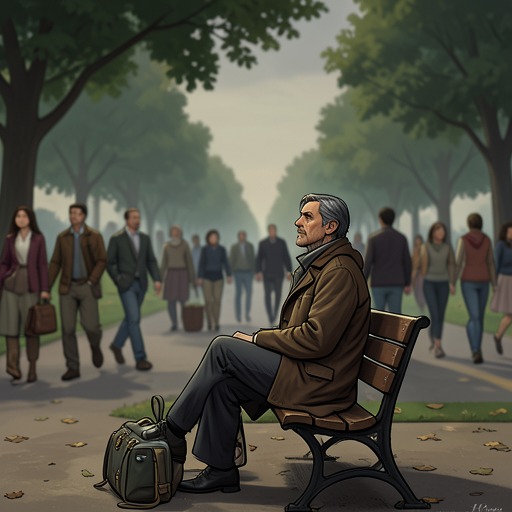
Loneliness
Brave New WorldLoneliness in Brave New World is more than the absence of company: it is a forbidden condition of inwardness, deliberately discouraged by the World State. The society trains people against solitude and arranges their lives to make it difficult to experience, so Helmholtz Watson’s attempt to write about being alone becomes an act of defiance, while John discovers that exclusion and compulsory togetherness can produce parallel forms of suffering.
A forbidden subject
The World State’s conditioning teaches people to reject solitude. Bernard Marx points out that citizens have received at least a quarter of a million warnings against it, describing the prohibition as embedded in their sleep-teaching rather than as a rule enforced only by direct authority. Loneliness is therefore not simply an unfortunate private feeling: the society tries to prevent the conditions in which it might arise or be examined.
Helmholtz’s poem makes that suppressed subject explicit. Its images include an abandoned city after a committee has dispersed, silent streets where crowds have been, and the absence of familiar bodies. The poem asks how an absence can seem to fill the night more solidly than physical intimacy. By giving absence and silence poetic weight, Helmholtz turns the emotional territory that social conditioning excludes into material for thought and art.
Helmholtz’s encounter with solitude
Helmholtz presents the poem during a lecture on the use of rhymes in moral propaganda and advertising. Rather than restrict himself to standard technical examples, he offers his own verses, hoping to make his students feel what he had felt while writing them. The experiment ends in institutional punishment: the students report him to the Principal, who threatens to dismiss him. His treatment shows how a subject can become politically disruptive simply because it invites people to feel beyond approved slogans and communal routines.
The poem also marks a change in Helmholtz’s sense of himself as a writer. Despite the trouble it brings, he feels that he is beginning to have something to write about and to use a latent power he had sensed within himself. His experience makes solitude more than a topic of forbidden verse: it becomes a source of artistic possibility, one whose seriousness the World State’s propaganda culture cannot comfortably accommodate.
John between exclusion and enforced company
John’s experience complicates any simple equation of loneliness with being physically alone. At Malpais, the pueblo shuts him out of communal activities, and he suffers from that exclusion. In civilized London, the pressure reverses: he cannot escape communal activity or find a quiet place to be alone. There, loneliness comes not from a lack of people but from the absence of privacy and chosen solitude.
This contrast gives the concept a double edge. Malpais shows the pain of being denied participation; London shows the pain of never being free of collective life. The World State’s claim to have overcome isolation rests on constant social presence, but John’s inability to withdraw makes that presence itself oppressive. In his exchange with Mustapha Mond, he connects being alone at night and thinking about death with the natural impulse to believe in God. Mond answers that people are kept from such solitude because the society makes them hate it and organizes their lives to make it almost impossible.
Social and spiritual significance
The discussion links loneliness to the possibility of reflection, faith, and unregulated feeling. Mond’s account makes clear that solitude is prevented by design, while John’s opposed experiences show the human cost of both social exclusion and relentless social integration. The society does not merely supply company; it controls the conditions under which a person might encounter private thought.
Helmholtz’s poem and John’s argument expose different consequences of that control. For Helmholtz, the forbidden subject opens a new field for writing; for John, the inability to be alone intensifies a conflict already shaped by exclusion. Together, they make loneliness a measure of the gap between communal conformity and individual experience: a state the World State tries to erase, yet one that returns in art, suffering, and the desire for spiritual meaning.